 PAY IN 4 WITH SEZZLE



Where to Place a Thermometer in a Turkey: Temps & Tips
2026 Nov 12th
Insert a digital thermometer into the thickest part of the turkey breast, then into the innermost part of the thigh where it meets the body, keeping the tip away from bone, fat and the cavity. Health Canada recommends a whole turkey reach 82 °C (180 °F) and stuffing reach 74 °C (165 °F).
One reading is never enough. The breast, thighs, wings and stuffing all cook at different rates, so a single easy-to-reach spot can tell you the bird is done when part of it isn't. Whether you're roasting for Thanksgiving, Christmas or a Sunday dinner, here's exactly where to check, how to read your thermometer and what to do once the turkey hits temperature.
Where to Put the Thermometer in a Turkey
Here's where to check turkey temp on a whole bird. Always take readings in the breast and thigh; the wing and stuffing give you extra certainty.
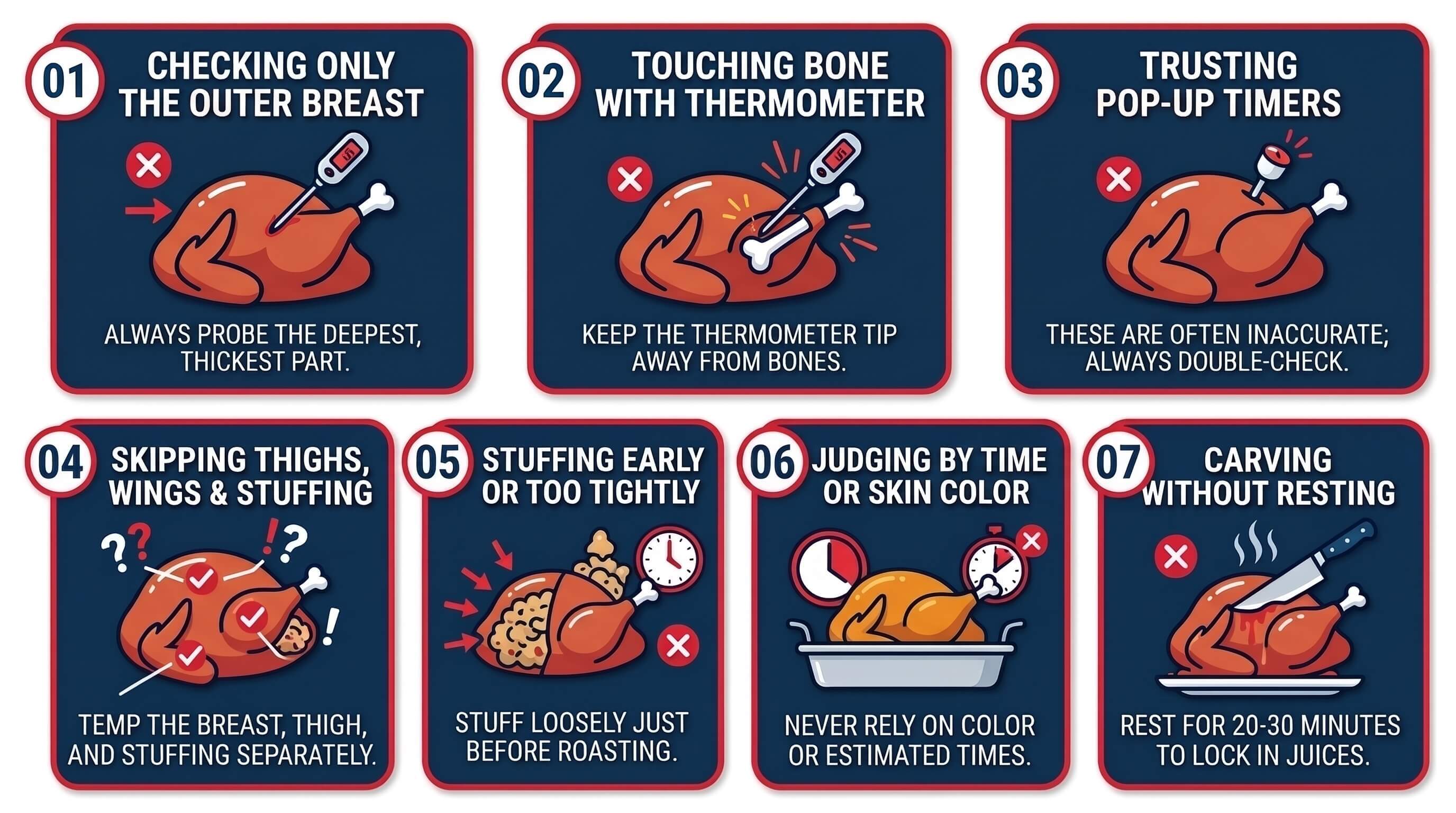
- Breast: Insert the probe into the thickest part of the breast, from the side if you can, so the tip sits in the centre of the meat. Keep it off the breastbone and out of the cavity.
- Thigh: Push into the innermost, meatiest part of the thigh, near where the leg joins the body. Stay clear of the hip joint.
- Wing: Check the innermost part of the wing, close to the body.
- Stuffing: If the bird is stuffed, take a separate reading at the centre of the stuffing.
Take more than one reading in the breast and thigh, since temperature can vary across a large muscle. Every meat reading on a whole turkey should hit 82 °C (180 °F), and the stuffing 74 °C (165 °F). If any spot comes up short, put the turkey back in the oven and check again after more cooking.
Why You Should Avoid Touching Bone
Bone conducts heat differently from muscle, so a probe resting against it can show a temperature that doesn't reflect the meat around it. Fat pockets and the open cavity skew readings too. If a number looks unusually high or low, reposition the probe and test again.
How to Use a Meat Thermometer Correctly
An accurate reading starts with the right tool. We recommend a digital thermometer for the most accurate results. An instant-read model is ideal for checking several spots near the end of cooking, while an oven-safe probe thermometer can stay in the breast as the turkey roasts, so you can track progress without opening the door.
Before you start, wash the probe in warm, soapy water and check its accuracy: in a glass of ice water, it should read 0 °C (32 °F). Insert the probe far enough that its sensing area sits in the centre of the meat, wait for the number to settle, and clean the probe again before you test another food.
When to Begin Checking the Temperature
Start checking 30 to 45 minutes before the estimated roasting time is up. Pull the pan out of the oven and close the door while you take readings; probing with the door open lets heat escape and slows cooking. A pop-up timer gives a rough signal at best and doesn't replace a reliable food thermometer.
What Temperature to Bake a Turkey in the Oven
Roast a whole turkey with the oven set no lower than 163 °C (325 °F). Place the bird breast-side up on a rack in a shallow roasting pan. Cooking time depends on the turkey's weight, whether it's stuffed and how accurate your oven is, so plan with a timetable but finish with a thermometer. For a full cook-backwards schedule, see our Thanksgiving dinner guide.
Don't rely on colour, clear juices or cooking time alone. Turkey can look done before it reaches a safe internal temperature, and properly cooked meat can still be slightly pink.
What Temperature to Cook Turkey To
Health Canada's safe internal temperatures for turkey are:
- Whole turkey: 82 °C (180 °F), measured in the thickest part of the breast and thigh.
- Turkey pieces cooked on their own (a breast roast, legs, thighs or wings): 74 °C (165 °F).
- Stuffing, whether cooked in the bird or in its own dish: 74 °C (165 °F).
We recommend cooking stuffing separately, in the oven or on the stovetop. If you do stuff the bird, stuff it loosely just before it goes in the oven and take all the stuffing out as soon as the turkey reaches 82 °C. If the stuffing hasn't reached 74 °C by then, spoon it into a baking dish and finish it in the oven.
Once the turkey is at temperature, take it out of the oven and let it rest for about 20 minutes. Resting lets the juices redistribute and makes carving easier. The temperature may climb a little from residual heat, but don't count on that to reach the target: the turkey should read 82 °C before it leaves the oven.
How to Carve a Turkey After Checking Its Temperature
Good carving keeps the meat moist and gives you neat portions. After resting, set the bird on a large, stable cutting board, ideally one with a groove to catch the juices.
- Remove the legs by slicing through the skin between each thigh and the body, then cut through the joint.
- Separate the drumsticks from the thighs and slice the thigh meat.
- Cut down alongside the breastbone and follow the rib cage to lift off each breast half.
- Slice the breast across the grain.
- Remove the wings.
Use a sharp carving knife, and a board and fork that haven't touched the raw bird.
Common Turkey Temperature Mistakes
Frequently Asked Questions
Where does the thermometer go in a turkey breast?
Into the thickest part of the breast, ideally from the side, so the tip reaches the centre without touching the breastbone or entering the cavity.
Can I leave a thermometer in the turkey while it cooks?
Yes, if it's labelled oven-safe. Instant-read thermometers aren't built for the oven: insert one to take a reading, then remove it.
Is turkey done at 165 °F (74 °C)?
It depends on what you're cooking. Health Canada recommends 74 °C (165 °F) for turkey pieces, such as a breast roast or thighs, and for stuffing. For a whole turkey, the recommendation is 82 °C (180 °F). Many American recipes use 165 °F for whole birds because that's the USDA figure, so if you're following Canadian guidance, keep roasting a whole turkey until it reaches 82 °C.
Should I cook the stuffing inside the turkey?
Health Canada recommends cooking it separately, in a baking dish or on the stovetop, until it reaches 74 °C (165 °F). Stuffing is moist and slow to heat through, which gives bacteria a place to survive. If you prefer it inside the bird, stuff loosely just before roasting and remove it all as soon as the turkey is done.
Should I check the turkey thigh or breast first?
Either one, but both need to reach 82 °C (180 °F) before the turkey is done. Check the breast, the innermost thigh and the innermost wing before you call it.
How often should I check the temperature?
Start near the estimated end of roasting. If the turkey is below temperature, keep cooking and check again after about 15 to 20 minutes, shortening the gap as it gets close to the target.
