



Induction Stove vs Electric: Power, Cost, and Everyday Cooking Compared
2026 Jun 3rd
Choosing between an induction stove and a traditional electric cooktop can feel complicated. This guide breaks down how each technology works, compares performance, power consumption, and details the true cost of ownership, so you can buy with confidence.
How They Work
Induction: Magnetic Heat That Starts in the Pan
Induction cooktops use electromagnetic fields to heat cookware directly. The glass surface itself stays comparatively cooler because energy is transferred into the pan’s metal, not the cooktop. This delivers fast heat-up times and precise control.
Electric (Radiant or Coil): Heating Elements Warm the Glass or Air
Traditional electric stoves rely on resistance elements. With radiant smoothtops, a glowing element heats the glass, which then heats the pan. Electric coils heat the air and the pan. Heat-up and cool-down are slower, and more energy is lost to the surroundings.
Cooking Performance
Speed and Control
- Boil time: Induction typically brings a pot of water to a boil 25–50% faster than standard electric.
- Precision: Induction offers fine-grained temperature control, especially at low simmer settings.
- Responsiveness: Heat adjustments on induction are nearly instant; electric elements lag when ramping up or cooling down.
Safety and Everyday Usability
- Surface heat: Induction surfaces run cooler and often include pan-detection auto shutoff for added safety.
- Spill cleanup: Because spills don’t burn on as easily with induction, wipes are simpler. Electric radiant tops can bake-on messes.
- Noise: Induction may produce a low fan hum or gentle buzz with some pans at high or pulsing settings.
Cookware Compatibility
Induction requires ferromagnetic cookware; cast iron and many stainless-steel pans work. If a magnet sticks strongly to the bottom, it’s a good match. Aluminum, copper, or glass pans need a magnetic base to function. Electric stoves accept virtually any flat-bottom pan.
Energy and Power
Power consumption of an induction cooker vs. an electric stove
When comparing the two, induction is typically more efficient because energy is directed into the pan, not the cooktop or surrounding air.
Efficiency in Practice
- Induction: Often cited as being around 85–90% efficient in transferring energy to food.
- Electric radiant/coil: Commonly around 70–75% efficient.
Wattage and Circuit Needs
- Burner draw: Induction elements typically range from about 1,800 to 3,700 watts at maximum; electric elements often run 1,200 to 3,000 watts.
- Circuits: Full-size ranges of either type usually require a 240V circuit (often 40–50 amps). Portable single-burner induction units run on standard 120V outlets.
Real-World Energy Use
Induction’s speed and precision reduce on-time. For the same recipe, induction generally uses less total kilowatt-hours and generates less ambient heat, a bonus in warm climates where AC costs matter. Electric stoves can consume more energy per task due to slower response and higher heat loss.
Costs and Value
Upfront Cost
The cost of an induction stove vs. an electric stove varies by brand and features. Entry-level electric radiant ranges are typically less expensive than comparable induction models. However, prices for induction have dropped, and midrange options are increasingly competitive. Portable induction burners are a budget-friendly way to try the technology without replacing a full range.
Operating Costs
Because induction is more efficient, ongoing electricity costs are often lower compared to radiant electric for similar cooking tasks. Your savings depend on local utility rates and cooking habits. If you cook frequently, induction’s efficiency gains can add up over time.
Maintenance and Longevity
- Cleaning: Both types use a glass or ceramic top that benefits from nonabrasive cleaners. Induction’s cooler surface makes cleanup easier.
- Repairs: Induction uses more complex electronics; parts and service can be pricier. Electric elements and controls are simpler to service.
- Cookware: If you need to replace incompatible pans for induction, factor that into the total ownership cost.
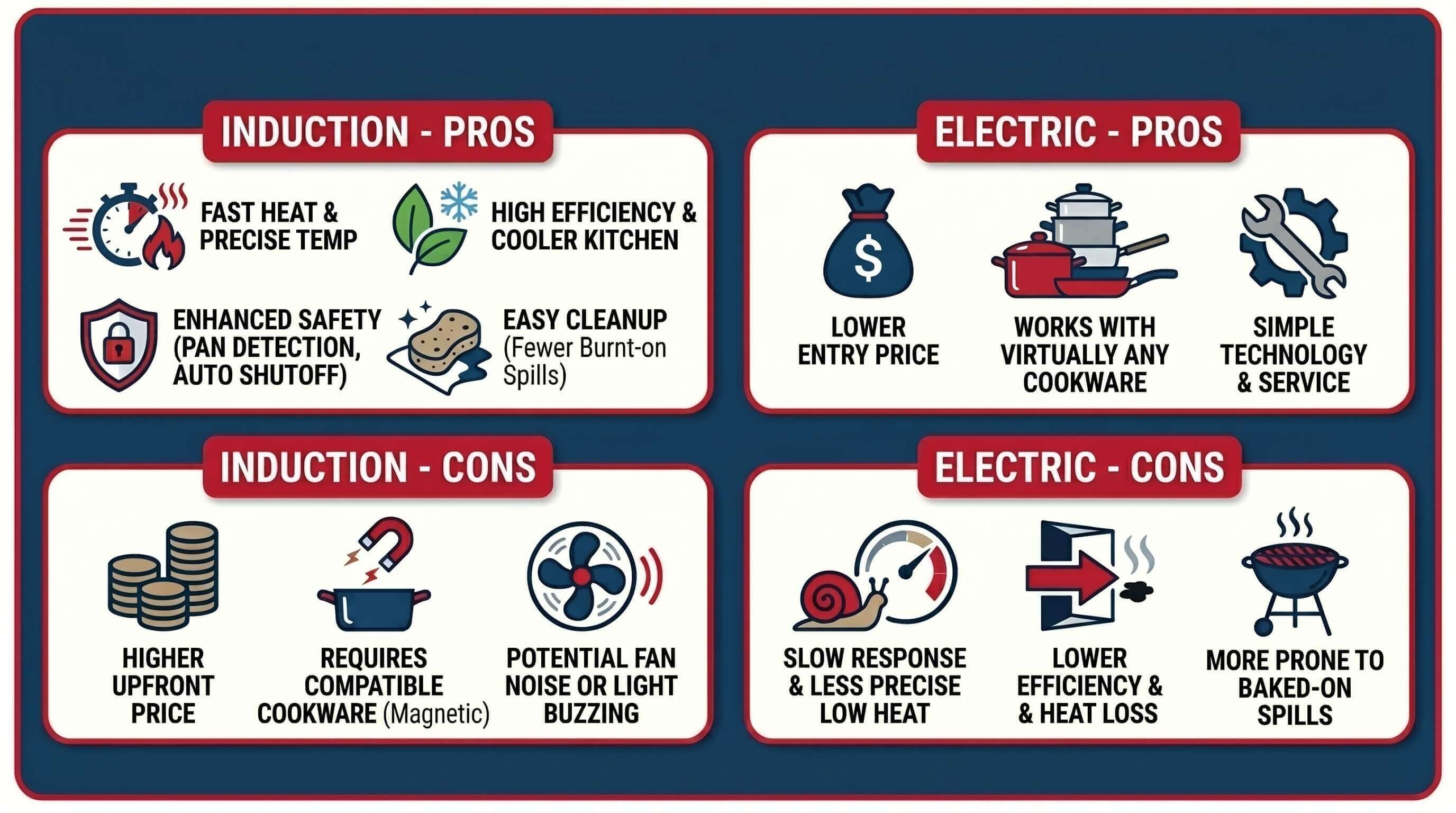
Pros and Cons at a Glance
Buying Tips
Match to Your Cooking Style
- Frequent cooks, precise simmering, or high-heat searing: Induction shines.
- Occasional cooking, tight budget, or diverse cookware: Electric radiant or coil may suffice.
Check Power and Space
- Confirm your kitchen’s electrical service supports the appliance's amperage.
- Measure cutouts for slide-in or drop-in models; verify ventilation clearances.
Test Your Pans
- Use a fridge magnet on the base. Strong attraction means induction-ready.
- Consider a hybrid set or an induction interface disk if you want to keep select pans.
FAQ: Induction vs Electric
Which is cheaper to run?
Induction typically costs less to operate for the same cooking tasks because it is more energy-efficient and cooks faster. Actual savings depend on your electricity rates and how often you cook.
What is the true cost of an induction stove vs. an electric stove?
Upfront, induction ranges generally cost more than comparable electric radiant models, and you may need compatible pans. Over time, lower energy use and faster cooking can narrow or offset the price gap, especially for frequent cooks.
Do I need special cookware for induction?
Yes. Pans must be ferromagnetic. Cast iron and many stainless-steel pans work; aluminum or copper pans need a magnetic base. If a magnet sticks strongly to the bottom, it should work.
Is induction safer than electric?
Both are safe when used correctly, but induction surfaces stay cooler and include pan-detection auto shutoff, reducing burn risk and accidental activation. Always follow the manufacturer’s safety guidance.
Will induction interfere with medical devices?
People with implanted medical devices should consult their physician and the device manufacturer. Modern induction units are designed to meet safety standards, but personalized medical guidance is important.
Does induction require special wiring?
Full-size induction and electric ranges usually need a dedicated 240V circuit. Portable single-burner induction cookers use a standard 120V outlet. Check appliance specifications before buying.
