


Best Induction Cookware: The Complete Guide to Choosing Pans, Sets, and Woks
2026 Aug 17th
Shopping for the best induction cookware can feel overwhelming, especially with so many materials, sets, and claims to compare. This guide explains how induction works, what to look for in induction-ready pots and pans, and how to build a versatile kit, whether you want a single frying pan, a full induction cookware set, or a high-heat induction cookware wok for stir-fries.
What Makes Cookware Induction-Ready?
How induction works (and why it matters)
Induction cookware has a magnetic base that can be heated by an induction cooktop’s electromagnetic field. Instead of warming a burner that then warms the pot, induction transfers energy directly to the ferromagnetic layer in the pan. The result is extremely fast heat-up, precise control, and less ambient kitchen heat.
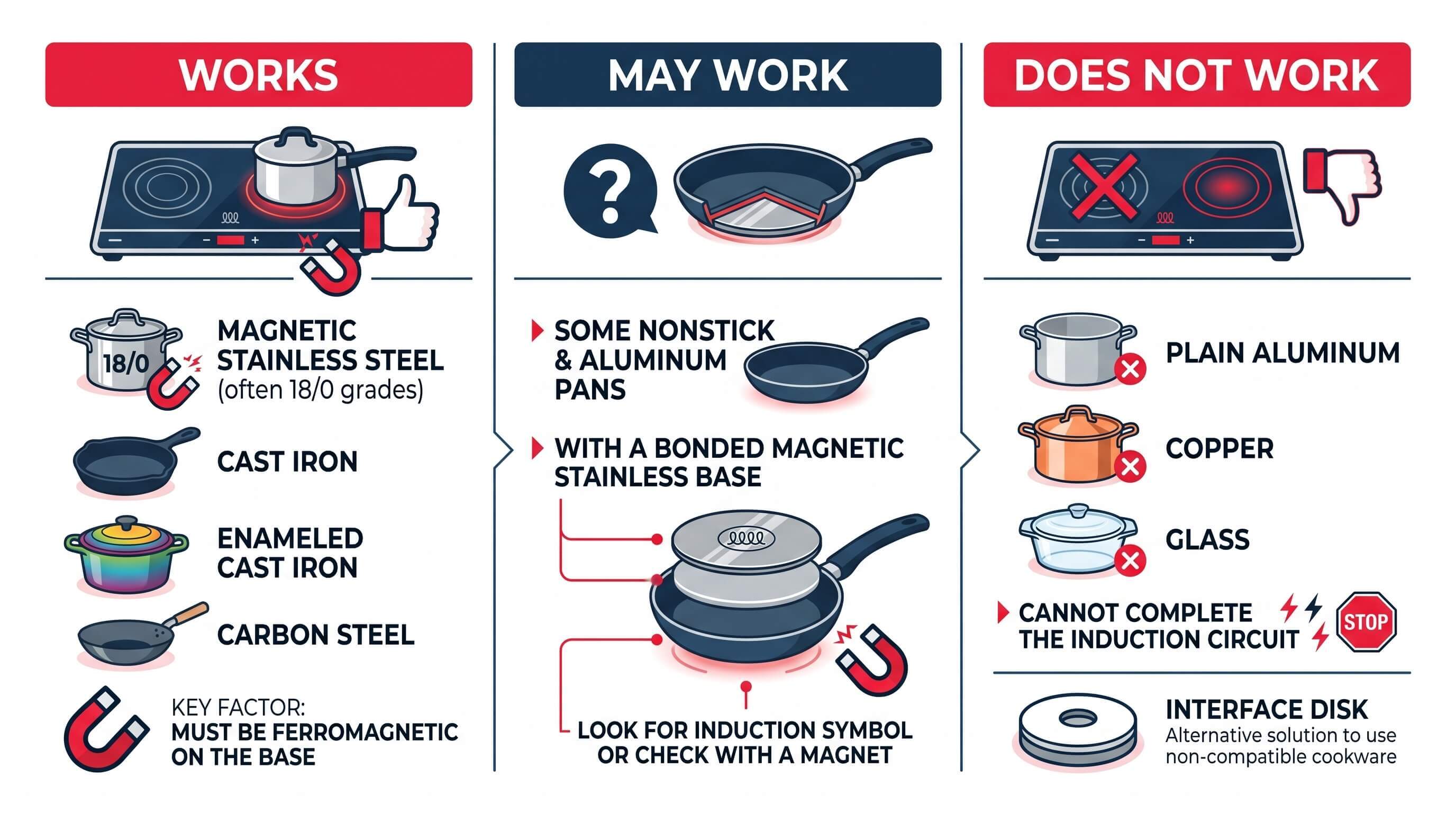
Materials that do and do not work
Quick compatibility check
- Magnet test: if a fridge magnet sticks firmly to the base, the pan is likely induction-compatible.
- Flatness: a flat, stable base ensures full contact and even heating.
- Base diameter: choose a size that matches your hob’s induction ring for best performance.
Choosing the Best Induction Cookware Pans and Sets
Key features to prioritize
- Fully clad construction: multi-layer cookware (e.g., tri-ply or 5-ply) with an aluminum or copper core sandwiched between stainless layers for even heat.
- Magnetic base: look for clearly stated “induction-compatible” or “induction-ready.”
- Stability and flatness: warp-resistant bases prevent buzzing and hot spots on induction.
- Oven-safe hardware: stainless or cast handles and metal lids expand your cooking methods.
- Durable finishes: metal-utensil-safe stainless interiors outlast many nonstick coatings.
Material breakdown
Fully clad stainless steel
Often the most versatile choice for induction cookware pans. Tri-ply and 5-ply designs spread heat evenly, sear well, and resist warping. Look for magnetic stainless on the exterior (commonly 18/0) for strong induction response.
Cast iron and enameled cast iron
Excellent heat retention and browning. Perfect for steaks, stews, and bread. They are heavy and heat more slowly, but once hot, they are exceptionally steady on induction.
Carbon steel
Lighter than cast iron with similar high-heat performance. Great for searing and stir-frying. It requires seasoning, which creates a natural nonstick over time, ideal for an induction cookware wok with a flat bottom.
Nonstick (with magnetic base)
Convenient for eggs and delicate foods. Check that the base includes a magnetic stainless plate. Avoid overheating nonstick on induction; use medium heat and follow the manufacturer’s temperature limits.
Sizing and hob matching
- Skillets: 8–12 inches cover most needs; 12 inches is best for family-size searing.
- Saucepans: 1.5–3 quarts for sides and sauces; 3–4 quarts for soups and grains.
- Dutch oven or stockpot: 5–8 quarts for braises and batch cooking.
- Wok: choose a flat-bottom 12–14 inch carbon steel wok for strong contact on induction.
Smart Setups for Different Cooks
Starter kit: value-focused induction cookware set
For first-time buyers, a compact induction cookware set with a 10-inch skillet, 2-quart saucepan with lid, and 5-quart Dutch oven covers daily cooking. Seek fully clad stainless for durability and even heat, with measuring marks and vented lids for convenience.
Enthusiast build: performance and flexibility
- 10- and 12-inch clad stainless skillets for searing and sautéing.
- 3-quart saucier for whisked sauces and risotto (rounded sides make stirring easy).
- 6–8 quart enameled Dutch oven for braises and bread.
- Carbon steel skillet for ultra-fast heat response and high-heat searing.
Stir-fry specialist: induction cookware wok
Choose a flat-bottom 12–14 inch carbon steel wok. Preheat gradually on medium, add oil, then crank heat. Induction’s rapid power suits quick, high-heat cooking; just ensure full-base contact. A lid is useful for steam-frying and quick braises.
Care, Maintenance, and Safety on Induction
Everyday care
- Preheat gradually: jump from low to medium-high instead of maxing out instantly.
- Avoid dragging: lift pans to protect the glass surface.
- Clean promptly: warm water, mild detergent, and non-abrasive pads preserve finishes.
Prevent warping and buzzing
- Match pan size to the coil and keep the base flat on the surface.
- Avoid thermal shock: let a hot pan cool before rinsing with cold water.
- Turn down power once at temperature; induction responds instantly.
Efficiency and safety
- Induction heats only the pan, cutting wasted energy and kitchen heat.
- Cooktop stays cooler, reducing burn risk and making cleanup easier.
- Auto shutoff and pan-detection features add peace of mind.
FAQs
How do I test if my pan works on induction?
Use a magnet on the base. If it sticks strongly, it is compatible. This quick check is the easiest way to confirm that induction cookware pans you already own or plan to buy will function properly.
Do I need a special induction cookware set, or can I buy pieces one by one?
You can do either. A curated induction cookware set is cost-effective and ensures matching lids and handles. However, building a mixed-material kit (stainless for everyday use, cast iron for searing, and a nonstick egg pan) often delivers better performance across tasks.
Is nonstick safe on induction?
Yes, as long as the pan has a magnetic base and you respect the coating’s heat limits. Use medium to medium-high heat for best results. Avoid preheating an empty nonstick pan on high power boost.
Can I use a round-bottom wok on induction?
Round-bottom woks do not make sufficient contact with the glass and coil. Choose a flat-bottom carbon steel induction cookware wok to get proper heat transfer and classic stir-fry results without a ring adapter.
Why does my pan buzz on high power?
Minor buzzing can occur with layered bases at very high settings, especially if the pan is slightly warped or oversized for the coil. Reduce power slightly, ensure a flat, clean contact, and match the coil to the pan’s base diameter.
