





Knife Buying Guide: German VS Japanese
2025 Dec 17th
When shopping for a new knife, there are many different styles, brands and qualities to choose from, but most kitchen knives fall into one of 2 categories: German or Japanese. Given the two's vastly different durability and intended uses, the decision is usually based on the individual’s cooking style. Below, we will go through a few of the differences between the styles, as well as the pros and cons associated with each design.
First off, when looking for a new knife, the main differences between a German and Japanese knife are steel thickness, steel hardness, and edge angle, with each one resulting in different culinary outcomes depending on the use.
German Knives
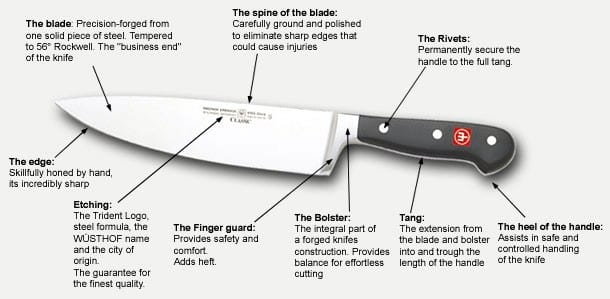
German knives are by far the most robust and common knives in the knife world, with all high-quality manufacturers based out of, essentially, the forged steel capital of the world - Solingen, Germany. These manufacturers include the likes of Wusthof and Zwilling J.A. Henckels. They have been leaders in their craft for over 200 years. German companies have become known for producing knives with a full-tang bolster. This means the blade starts from the tip of the knife and continues all the way to the bottom of the handle, while having a heavy “bolster” in the middle providing balance and extra strength when cutting through hard meats and vegetables.
These knives also usually have a rating of 56 to 58 on the Rockwell hardness scale, meaning that their steel is much more forgiving than their Japanese counterpart, as they are more prone to bending or rolling the edge, instead of cracking or breaking. To strengthen the steel durability even further, the blade angles on the German knives are usually between 16-22 degrees per side. Meaning that with a slightly thicker cutting edge, the knife will retain its shape and edge longer. The cutting edge will vary, depending on the style of the knife, but with a German blade, you can trust that you will be able to enjoy a lifetime of use.
Pros:
- Robust
- Wide selection
- All-purpose design
- Dishwasher safe (poly handles)
- Durable enough for chopping through small bones
- Almost any “western” style knife sharpener can restore an edge
Cons: Weight
German Knife Construction:
Japanese Knives
Japanese knives have been becoming more and more popular over the past 20 years, with emerging knife companies such as Shun, MAC, Miyabi, Global, and Kasumi. With most companies based out of Seki Japan, they are producing very high-end knives with breathtaking Damascus steel designs and construction. Most knives average a much harder 60-62 on the Rockwell hardness scale, however, making these knives a bit more brittle than the German forged steel. This hardness does allow them to produce a much thinner knife and edge, allowing for almost effortless cuts, but they can be prone to cracks and chips when misused (dropped) or if they hit something hard, such as bone.
These have become the showpiece of any chef’s collection in recent years, especially for those within the Sushi and Vegetable prep fields, as they allow for thinner and more precise cuts, using very minimal effort. Japanese knives also sport a much finer, straighter edge, usually ranging from 14-16 degrees, which makes it easier to facilitate clean, precise slices.
Pros:
- Lightweight
- Beautiful
- Thin
- Allow for very precise cuts
Cons:
- Brittle
- Not dishwasher safe
- Knife sharpener should be specific to the knife line or hand sharpen only using a whetstone.
Notables: Bob Kramer
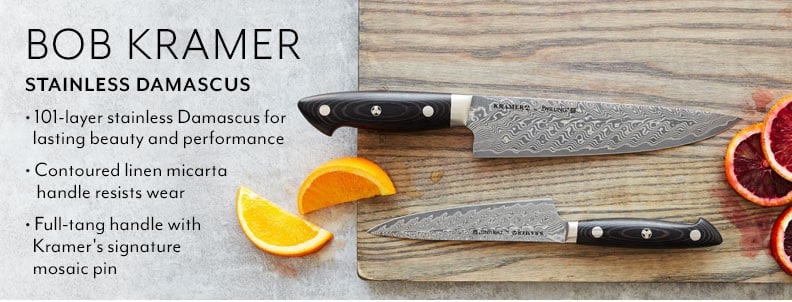
Bob Kramer is an American Master Bladesmith and is widely recognized as “the greatest American knifesmith working today”. Being traditionally trained, Bob’s knives are a combination of old-fashioned Japanese craftsmanship, German styling, and modern technology. Teaming up with Zwilling J.A. Henckels back in 2011, they were able to offer master bladesmith quality blades to the end-user for a fraction of the cost. His styling offers the best of East meets West craftsmanship and will be sure to stand out in any collection.
In all, the right style for you will depend largely on your intended task at hand. With German specializing in harder, more robust jobs, the Japanese specialize in delicate cuts. Nowadays, you really can’t go wrong with either, as the difference between each is diminishing, with some German knives now sporting 14 to 20 degree angles and Japanese steel using new alloys to help improve durability.
Hopefully, our German vs Japanese Knives Buying Guide has provided clarity on which knife you need for which purposes. If you have further questions on knife buying, call our store and we're happy to share our decades of experience with you in a "human" knife buying guide!
